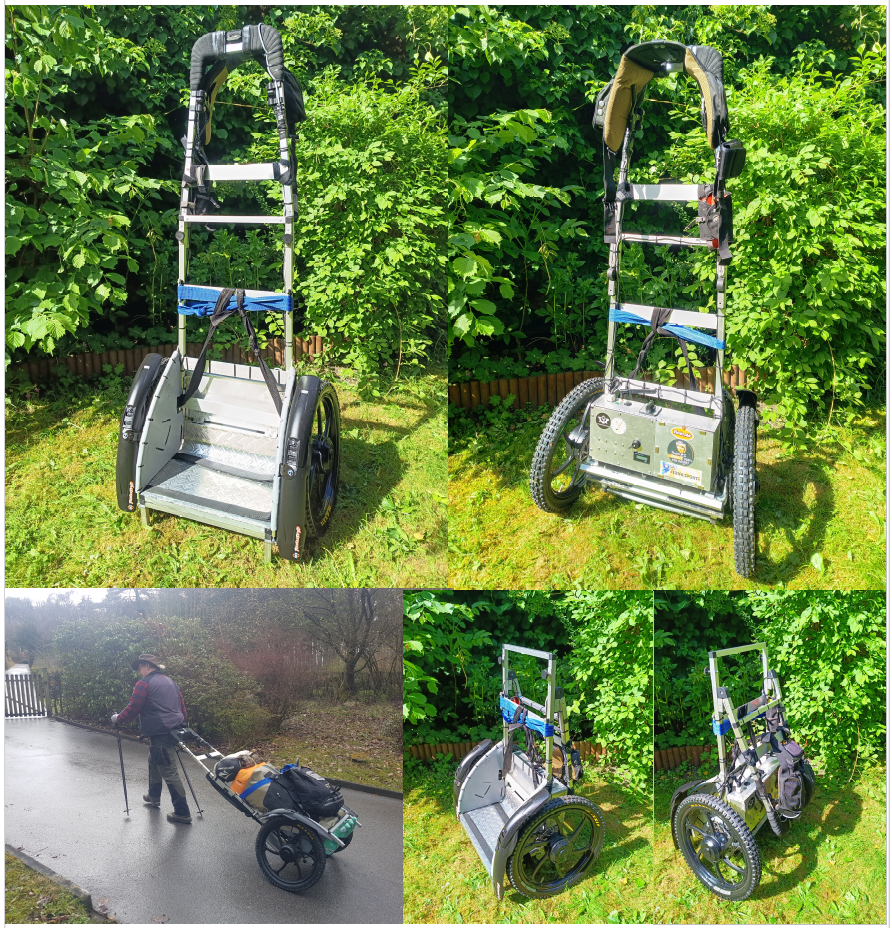
Ich hab ja mittelerweile schon ein paar mal fallen lassen das ich an einem speziellen Wanderwagen bastel und einige von euch habe ihn ja auch schon live gesehen, deshalb kommt hier mal eine Vorstellung.
Da ich die Beschreibung auch noch anderweiting verwenden möchte habe ich sie auf Denglisch verfasst aber ich denke die meisten von euch werden damit klar komen.
(Alle typos sind natürlich copy right protected und nur eingefügt um die Aufmerksamkeit des Lesers zu erhöhen  )
E-Motor
supported hiking trolly TR3-E
2x2
Features
The TR3-E is designed as hiking trolly for easy
to medium rough terrain
like typical hiking trails in Germany’s low mountain ranges. The
supported load capacity allows to carry luggage and
water for extended hiking without
restriction in comfort. The battery is
dimensioned to achieve in the dedicated terrain
a travel range between recharging of at least 100km. Allowing for 5
to 7 days in nature before need for civilization ( at my traveling
speed).
Two operation modes are currently supported. The “Direct” mode
were the measured pulling force at the hip belt is directly answered
with pushing force from the wheels. And the “Crouse” mode were
the pulling forces are averaged and answered with an steady helping
response from the wheels. A special mode for stairs is planned.
Two separate sensors measure the pulling forces and thereby allow
an individually adjusted wheel control. By this the support can be
adjusted to going tight bends or overcoming obstacles in front of one
wheel without excessive side pulling of the drawbar.
The provided power allows a (nearly) effortless going even on
steepest inclines, as long as at least one of the heavy profiled
tires finds any grip. The two individually controlled breaks allow
easy descending steep slops and smooth going down stairs.
The safety monitoring will limit the wheel speed if a single wheel
turns free and cut off the motor support entirely if excessive
tilting of the trolly is detected. By this a tipping of the trolly
can mostly be prevented or if an accident happened the motors are
switched off immediately. As last resort exists a predetermined
breaking point at the connection between drawbar and hip belt.
A separate water bottle storage below the bottom plate works as
counter weight to further reduce the remaining hip load. Additional
side effects that a leaking water bottle can not soak the main
luggage and the water is always quickly accessible.
The
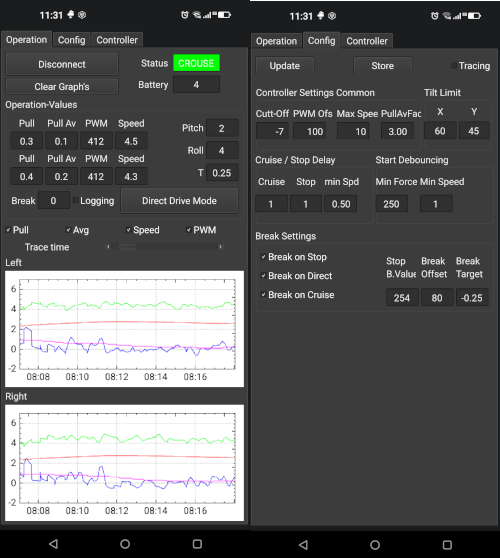
trolly allows a direct WIFI connection of the mobile phone with an
dedicated app. This app allows on the one hand to visualize the
operation conditions like pulling forces, applied motor power and
speed and on the other hand to adjust all relevant operation
parameter of the control software. By this it is at any time possible
to adust the behavior of the trolly if something could be optimized.
Beside this the app also allows to enable a detailed logging of all
internal operation values of the control software to provide valuable
debugging information.
Screen shot's of the app
Functionality in detail
Direct mode
In “Direct” mode the measured pulling force of
one sides sensor is directly answered by a corresponding push
force of this sides wheel. This mode is especially useful in
trick terrain where lots of obstacles have to be overcome or
going up steep inclines where strong support needed but a steady
walking is not possible.
Cruise mode
In “Cruise” mode the pull forces of both sensors
are averaged over a couple of seconds and both wheels answer with
the same push force to this averaged pull. This mode removes the
constant acceleration and deceleration resulting from our normal
walking motion. Also the “false pull” which results from up/down
swinging of the drawbar on every step is removed by the
averaging.
This mode is the main mode of the trolly operation and used
whenever a steady walking is possible. The trolly will adjust
gradually to any change in pulling force and thereby allow nearly
effortless walking independent of the steepness of the terrain.
Breaking
For down hill walking the trolly provides electronic
wheel breaking. The electronic breaking works in both modes and
prevents excessive pushing of the trolly. This allows an easy
down hill walking without heavy load on the knees. However, the
electronic breaking can not achieve a full blocking of the wheels
but can create a high resistance only.
On very steep descents, tricky down hill sections, stairs or
any other situation where the electronic breaking is not
sufficient, the manual brakes can be used. The two breaks are
operated and controlled individually via the two break handles
located at the top-end of the drawbar. The break handles allow to
lock the breaks permanently as a kind of parking break. This
prevents the trolly from moving if left alone, especially on
uneven terrain.
Adjustment
For mode selection, calibration and support adjustment
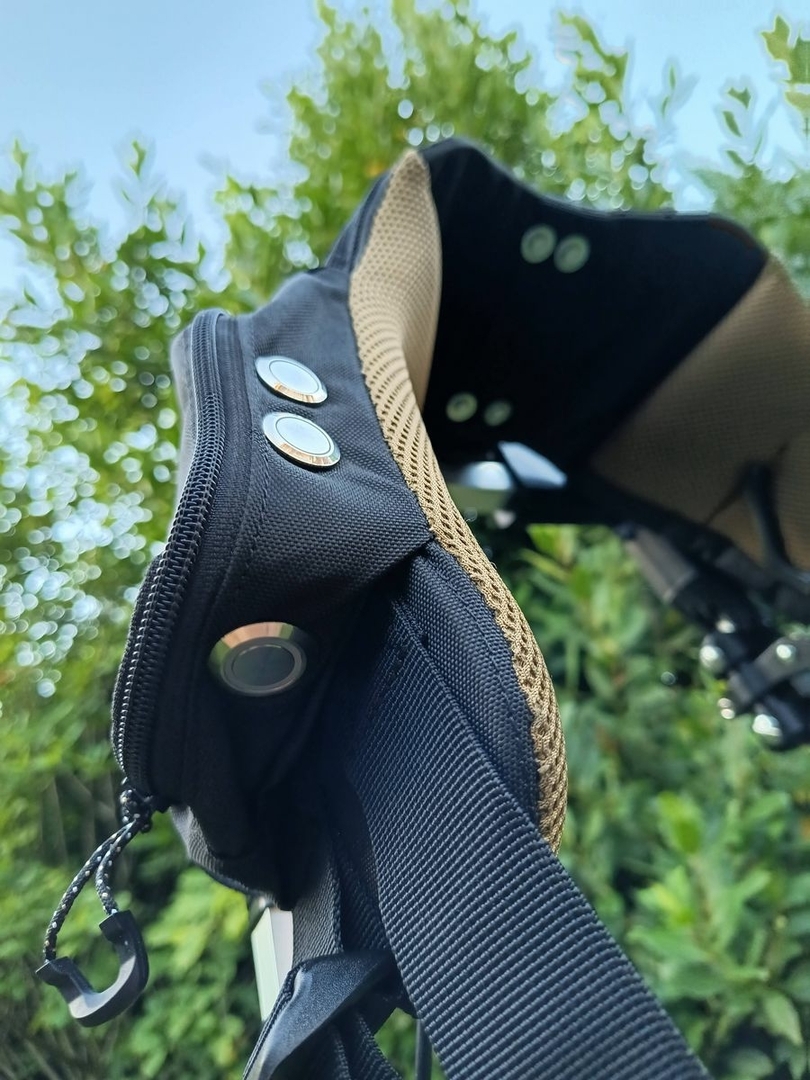
three buttons are located on a patch pocket of the hip belt. The
main button at the front and the two adjustment buttons on top
of the pocket.
To calibrate the pull sensors to different luggage arrangements
a long press on the main operation button is required each time
the trolly is powered on. Pressing the button for about two
seconds will initiate the calibration sequence and two seconds
later the inbuilt LED of the butte indicates that the trolly is ready
to support in “Cruise” mode. Anther press on the main button
will disengage the “Cruise” mode. Once calibrated and
disengaged, the “Cruise” mode can be engaged again with just
a single click of the main button at any time.The two adjustment
buttons on the top of the pocket allow to adjust the desired
remaining pull or uphold force of the trolly. By this the trolly
can be adjusted to just follow without significant pulling effort
but also without annoying pushing. In combination with the main
button the other operation modes are selectable.
Mechanics
Dimensions
The overall height of the
trolly is 170cm. The drawbar can be folded to reduce the height
to 110cm. The track width 75cm, the depth is 60cm and the ground
clearance is 15cm. The drawbar angle is about 30°. Overall trolly wight ca. 30kg
Load capacity
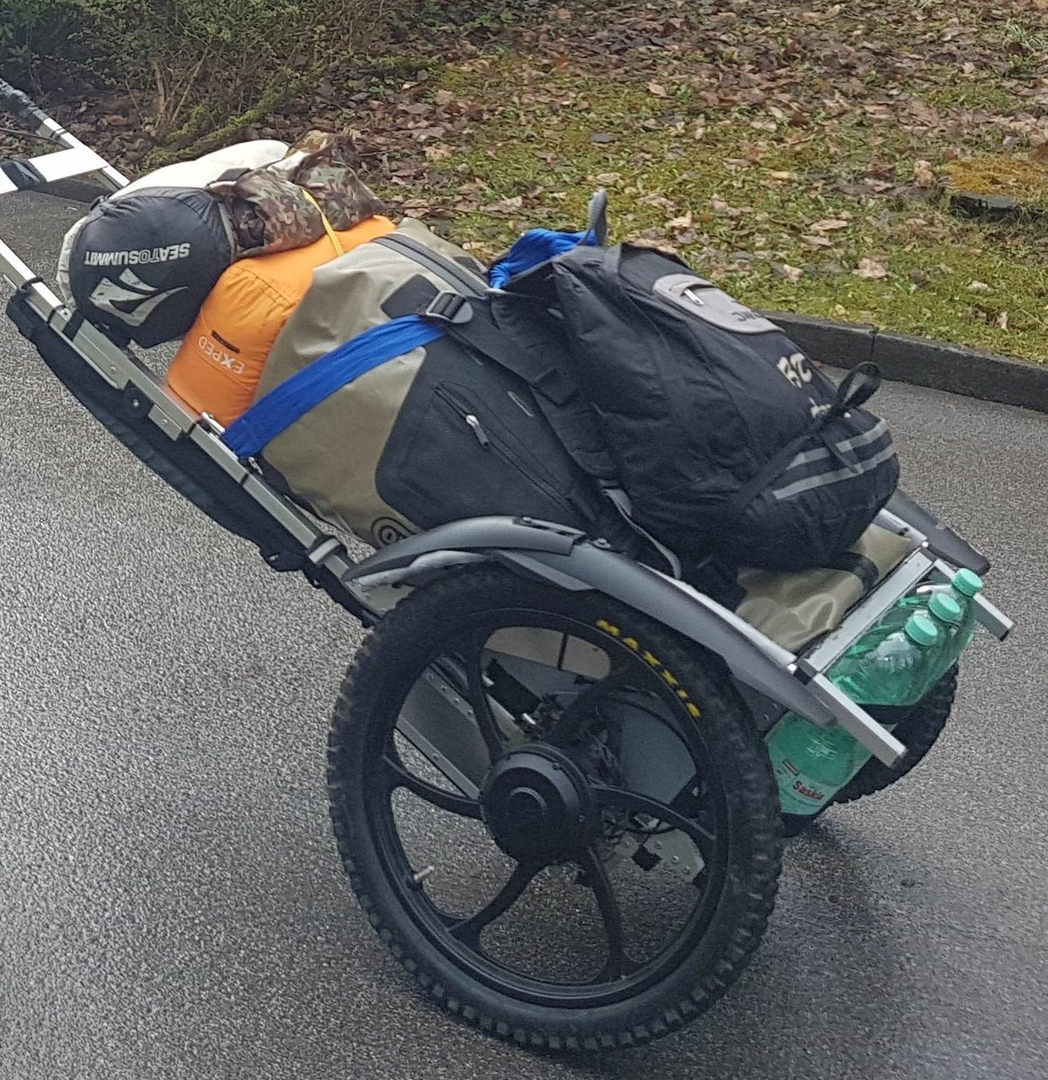
The opening supports bags
up to a width 43cm and height of 30cm. Two fix attached luggage
belts secure the load. The trolly was tested with luggage load of
+30kg. Below the bottom plate is a holder for 4 x 1.5L water
bottles. At this place the water works as counter weight to
reduce the drawbar load on the hips.
Wheels
The two 20”
cast alloy wheels are equipped with hub e-motors. The wheels are
mounted with a camber of about -10°. The heavy profiled off road
tires are filled with a foam based puncture protection and are
covered by wide mudguards protect the luggage.
Breaks
Two independent disc brakes can
be controlled individually. Both brake handles support permanent
locking of the breaks.
Hip belt
A padded hip belt of from back
pack is used for the body attachment.
Trolly body loaded
Hip belt with control buttons
Electronics
Controller
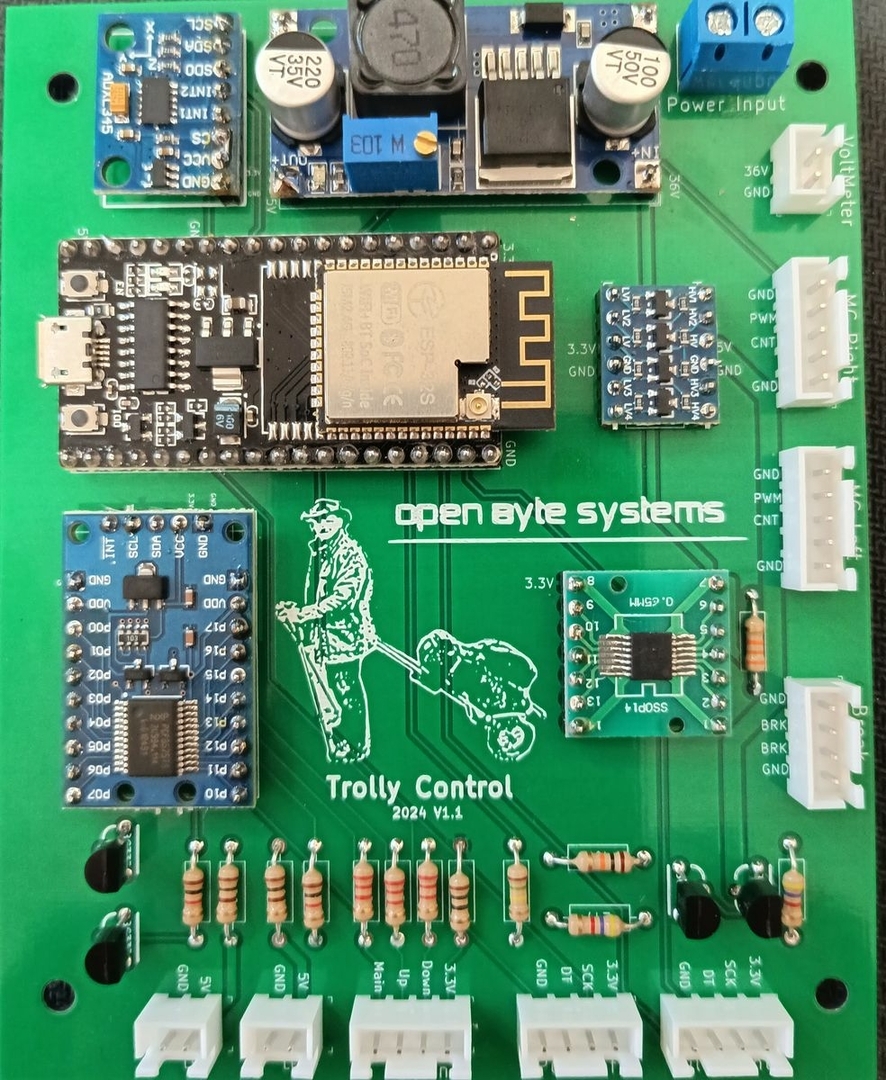
An ESP32 dual core
micro-controller with up to 240Mhz provides the required
computation power. The ESP32 provides 448KByte ROM and 520KByte
RAM. The micro-controller together with several supporting
components are placed on a custom PCB.
Motors
The BLDC motors with HAL
sensors are rated to 250W/350W with 42 Nm and operate on 36V.
Motor driver
Each motor is controlled
by an individual motor driver that supports a load of 15A
permanent and a peak of 20A. The driver output is adjusted via PWM.
An electronic break is controlled via an analogue 5V-12V signal
Battery
The battery is assembled out
of 160 individual 18650 cell, each with an capacity of 3500mAh
at 3.7V. The cells are arranged in a 10s16p configuration
providing 36V nominal with 560Ah. Charging and discharging is
controlled by an 10S 35A BMS
Pull Sensors
Two independent load cells
are used to measure the pull force between drawbar and hip belt.
The load is converted to digital values by two 24bit ADC’s
Accelerometer
A three axis
accelerometer provides orientation and acceleration information.
Push Buttons
Three push buttons on the
hip belt allow operation mode selection and support adjustment
LED’s
Two LED’s allow operation
mode identification and give visual control feedback.
Main Switch
A 20 pole switch provides
the battery separation for both motor drivers as well as the
driver to motor separation. The later ensures that the motors not
work
generator during unsupported pulling
of the trolly.
Trolly control PCB
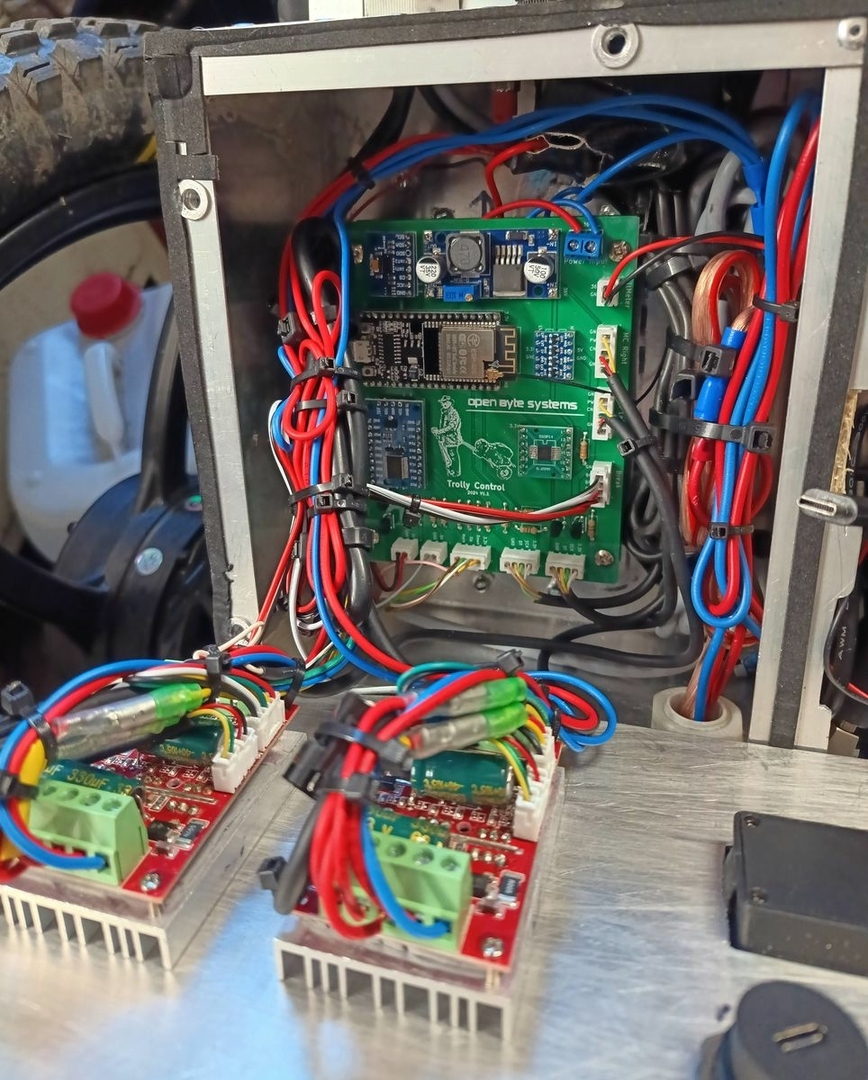
Electronic compartment
Software
The control software of the trolly is build with the help of the
ESP-IDF in C. This is a extensive support library of the ESP32 which
also provides extensions for IDE’s like Eclipse of VS-Code. The
underlying embedded operating system is a dual core tailored version
of FreeRTOS.
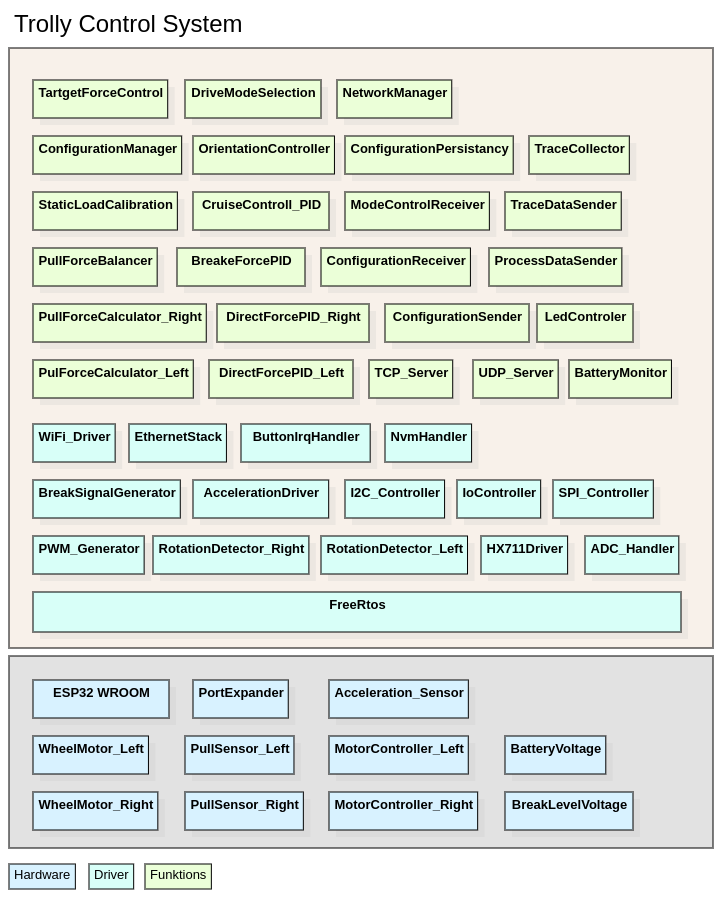
The diagram below shows the different hardware / software
components of the trolly control system